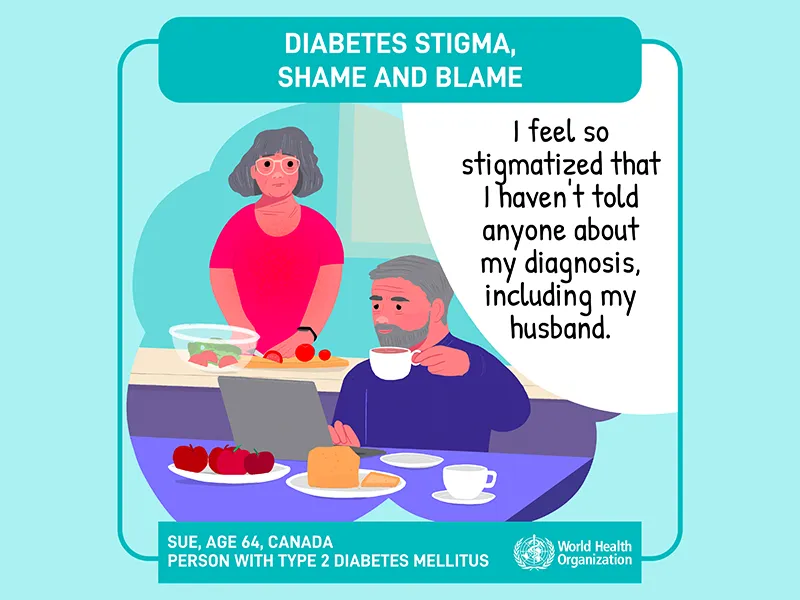
Those of us who live with diabetes know that diagnosis is just the beginning.The difficult part begins later, on a day-to-day basis.Not only because of glucose control, medication or constant decisions, but because of something that weighs much more than it seems: the stigma, judgments and misconceptions of those who do not live with this disease.
This article puts words to something that many of us have felt for years.And as a person with diabetes, I have seen myself reflected in each paragraph.
The shame that no one sees
You're probably familiar with the scene: you're eating out and you decide to order dessert.The looks, the awkward silences or the classic comment automatically arrive:
“Can you eat that?”
What you don't see is everything that lies behind.
Mental calculations, insulin adjustment, forecasting how glucose will respond, the sensor setting trends... It's not improvisation, it's management.
Diabetes is not black and white.It is not “you can” or “you can't”.It is balance, information and decisions in real time.And when someone questions those decisions, even if they do so with good intentions, it hurts.Because it conveys the message that we don't know how to take care of ourselves, when in reality we have been doing it every day, without rest.
“I'm sure it's because of what you ate…”
Another of the great weights we carry is guilt.
That widespread idea that diabetes appears due to “not having taken care of yourself.”
Nothing could be further from the truth.
Diabetes is complex.Genetics, the immune system, the environment, stress, sleep, hormones, physical activity are involved... Reducing everything to “eating poorly” is not only false, it is also unfair.And this constant judgment ends up taking its toll, causing many people to hide their diagnosis, avoid talking about it, or even miss medical appointments out of shame.
Living with diabetes is deciding... all the time
There is something I would like everyone to understand:
we never rest.
Every day we make dozens (or hundreds) of health-related decisions:
- What to eat and when
- How much medication to use
- Whether to exercise or not
- How stress, sleep or illness will influence
- What to do in the event of an unexpected rise or fall
And all of this while we work, take care of our family, go out with friends or simply try to live.
No two diabetes are the same
Another great truth: there is no single plan.
What works for me may not work for someone else.Comparing, judging, or giving unsolicited advice often creates more noise than help.
Technology, such as continuous glucose monitors, has given us something fundamental: information and autonomy.It allows us to understand our body, anticipate and make better decisions.Not so that others control us, but so we can live more peacefully.
Support matters (a lot)
Words matter.
Tone matters.
The way we ask, too.
Instead of saying:
- “You shouldn't eat that.”
- “Has he raised you again?”
- “I know someone who was cured…”
We can say:
- “How can I help you?”
- “Is there anything I should know to better accompany you?”
- “I trust you know what you need.”
That small change creates a safer, more humane and more respectful environment.
Diabetes does not define us
Having diabetes does not take away our desire to live, to travel, to enjoy, to play sports, to fall in love or to celebrate.
It is a serious illness, yes.
But we are not the disease.
With information, tools and support, you can live fully.And this is where the community makes the difference.
The strength of not being alone
If I have learned anything over the years, it is that sharing what we experience lightens the load.Reading other people who understand exactly what you go through, without explanation or judgment, is a gift.
That is why this forum has existed for so many years.And that is why it makes so much sense to support initiatives that arise from within the community, such as the book “Living with diabetes: The power of the online community.”It is not a medical manual, it is a reflection of real experiences, of mutual support and how the company of others changes the way of living with diabetes.
It is a book that can also greatly help couples, families and friends to understand each other better.
💙 If you live with diabetes, if you accompany someone who has it or if you simply want to better understand this reality, I encourage you to continue participating, sharing and taking care of this space.
There are no prejudices here.There are people here.
Because beyond the diagnosis, what we need is empathy, respect and community.