fer
05/29/2026 12:44 p.m.
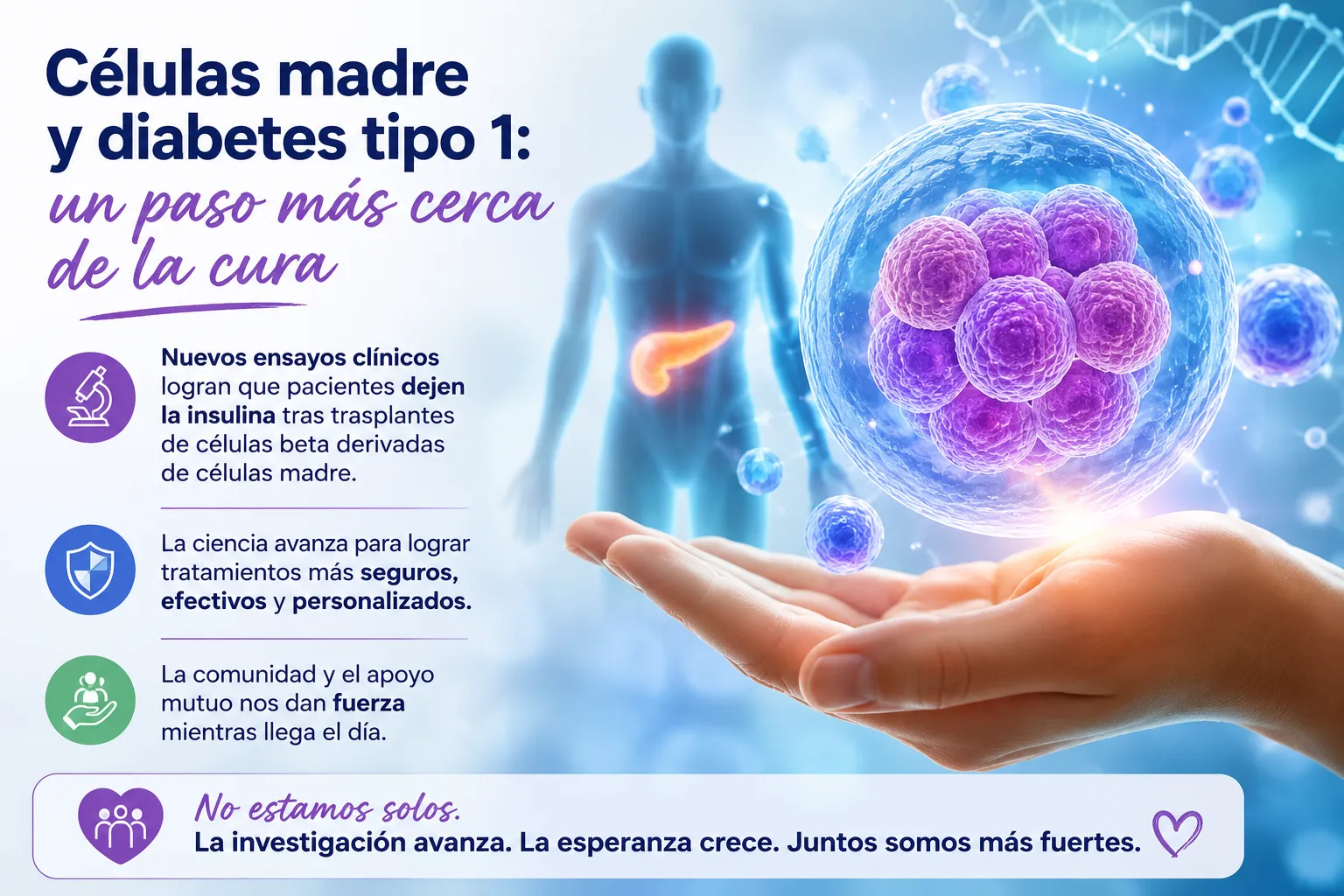
For years we have heard about stem cells as a possible way to cure type 1 diabetes. Many times it seemed like a distant promise, but the latest results are beginning to show very concrete advances.
In recent clinical trials, researchers have enabled people with type 1 diabetes to produce insulin again by transplanting beta cells created from stem cells.In one study, 10 of 12 participants stopped needing insulin six months after treatment.
Why is it so important?
Because beta cells are responsible for producing insulin naturally.In type 1 diabetes, the immune system destroys them and, from that moment on, we depend on external insulin to live.
The idea behind these therapies is simple to explain, although very complex to achieve: create new beta cells in the laboratory and transplant them to the patient so that they can perform their function again.
The results are very promising, but important challenges still remain.The main one is to prevent the immune system from attacking the new cells again.To achieve this, different solutions are being investigated, such as encapsulating the cells or even genetically modifying them so that they go unnoticed by the immune system.
It is important to remember that these treatments are still experimental and not yet available for general use.Still, they represent one of the most encouraging advances we've seen in recent years in the search for a cure for type 1 diabetes.
Personally, every time news like this appears I have the same reflection: after decades talking about a possible cure, it seems that we are beginning to see real results in people and not just in laboratories.
Do you think we will see a therapy capable of definitively replacing insulin during our lifetime?
Or do you think we are still far from that goal?
Diabetes Tipo 1 desde 1.998 | FreeStyle Libre 3 | Ypsomed mylife YpsoPump + CamAPS FX | Sin complicaciones. Miembro del equipo de moderación del foro.
Autor de Vivir con Diabetes: El poder de la comunidad online, parte de los ingresos se destinan a financiar el foro de diabetes y mantener la comunidad online activa.
Sígueme en Instagram
It's closer now.They have found the way.
Hija de 35 años , diabética desde los 5. Glico: normalmente de 6 , pero 6,7 la última ( 6,2 marcaba el Free)
Fiasp: 4- 4- 3 Toujeo: 20
LuVi
05/30/2026 6:10 p.m.
I already doubt that with the cake being divided between laboratories and pharmaceutical companies, they are going to allow the cake to go only to the first one who finds the key.There are many millions and interests here.We will see how they advance or let them advance, perhaps years ago finding the cure was a priority feat worldwide, seeing that the world has more and more inhabitants with what it entails, perhaps they will be more interested than some if the instance is shorter.
DMT1 desde los 12 años (1991)
hbA1c= 6,2
Humalog y Toujeo (mayo 2017)
Humalog y Tresiba (mayo 2016 hasta mayo 2017)
humalog y NPH (desde inicio hasta mayo de 2016)
We could say the same about cancer and there are more and more types that have a cure.What economic interest is involved?Sure.But we are forgetting the tremendous health cost of treating diabetes, and for that reason alone it is worth investing in its cure.
No signature configured, add it on your user's profile.
The research network is large.I have hope in China.Regardless of whether their system is better or worse, they do have a fierce incentive to eradicate diabetes, because business interests are diluted there.I hope solutions come soon.It is a complex world to have to live with these dependencies.
Health.
No signature configured, add it on your user's profile.
It has to come from public research, without pharmaceutical interests.
I also have confidence in Chinese researchers.
Hija de 35 años , diabética desde los 5. Glico: normalmente de 6 , pero 6,7 la última ( 6,2 marcaba el Free)
Fiasp: 4- 4- 3 Toujeo: 20
I trust more that the European-Americans will discover it, as they are the ones who have discovered practically everything.
Of course, maybe the Chinese copy it very quickly and bring it to us sooner and more accessible.
En 1922 descubrieron la insulina, en 1930 la insulina lenta. ¿Que c*** han hecho desde entonces?
Anything that affects the pockets of these multinationals will not succeed unless it is made public and unless anyone is capable of doing it in a small laboratory.
Apple has been saying for years that it is going to release a watch that measures glucose...
There has been a patent for this for 30 years, kept in a drawer of a large European multinational.
This is a billion dollar business and counting...
No signature configured, add it on your user's profile.
The solution will come to us but with obstacles.
First only children, then those under 30, and those over 50 will be left out, especially if you have other illnesses.
Yesterday I was left out of treatment for carpal tunnel neuropathy due to diabetes and cancer.Chemotherapy caused it, but public service leaves me out.
So it's not all thanks to the public.
Lada enero 2015.
Uso Toujeo y Novorapid.
fer
07/17/2026 11:27 a.m.
@Ruthbia, I understand perfectly what you are saying, and after experiencing a situation like the one you mention, it is normal that it is difficult for you to trust when you hear about new treatments.
Many times we think of a cure or an innovative therapy as something that will reach everyone equally, but the reality is that age criteria, comorbidities, costs or priorities usually appear that leave out part of the patients.If you have also just experienced that feeling with carpal tunnel neuropathy treatment, the frustration is totally understandable.
I think you make an important reflection: it is not enough that a solution exists, it also has to be accessible.The history of diabetes is full of advances that took years to reach the entire population.
Still, I hope that when these therapies become a clinical reality, the criteria will not be as restrictive as we fear.In the end, those of us who have been living with diabetes for the longest years are precisely those who could benefit the most from reducing complications and therapeutic burden.
Hopefully this time science advances faster than bureaucracy.💙
Diabetes Tipo 1 desde 1.998 | FreeStyle Libre 3 | Ypsomed mylife YpsoPump + CamAPS FX | Sin complicaciones. Miembro del equipo de moderación del foro.
Autor de Vivir con Diabetes: El poder de la comunidad online, parte de los ingresos se destinan a financiar el foro de diabetes y mantener la comunidad online activa.
Sígueme en Instagram
@Ruthbia, file a complaint, it is a simple operation, with local anesthesia.I have two colleagues operated on without any problem and in a short time.
.
Hija de 35 años , diabética desde los 5. Glico: normalmente de 6 , pero 6,7 la última ( 6,2 marcaba el Free)
Fiasp: 4- 4- 3 Toujeo: 20
@Regina I have been told that it is due to lymphedema in the arms and diabetes.
They cure your breast cancer, but there are several consequences that they don't tell you beforehand.
In short, the wear of the tunnel is due to age, diabetes and the chemistry of the chemotherapy.At the moment 3 fingers are falling asleep on my left hand and a little on the right.
Lada enero 2015.
Uso Toujeo y Novorapid.